Welcome To HuiXin IOT : Pioneering RFID Solutions for a Connected World!
In the hospitality industry, guest experience and operational efficiency are critical competitive factors. Over the last few decades, the way hotels manage Access control has changed dramatically. What was once a purely mechanical system—metal Keys and physical locks—has evolved into sophisticated electronic solutions powered by RFID (Radio Frequency Identification) and NFC (Near Field Communication) technology. Today, hotel Access Cards do more than just open doors; they are part of branding strategies, data collection systems, and even gym management solutions.
This article explores the journey from traditional inn Keys to modern RFID Cards, the costs and design considerations behind Key Cards, and how RFID has transformed hotel operations and guest convenience.
In the early days, hotels relied exclusively on metal Keys. While reliable, they had major drawbacks: they were bulky, easy to duplicate, and costly to replace if lost. Additionally, managing a large inventory of Keys was inefficient, especially in larger hotels.
With the introduction of electronic locks in the late 20th century, hotels began transitioning to magnetic stripe Key Cards. This was a major improvement because Cards were inexpensive, easy to reprogram, and eliminated the need for changing physical locks when guests lost their Keys.
However, magnetic stripe systems had limitations: Cards were prone to demagnetization, could be easily copied, and offered limited data storage. The natural progression was toward RFID-based Smart Cards, which introduced contactless convenience, stronger encryption, and integration with broader hotel management systems.
RFID technology offers unique advantages that make it a perfect fit for the hospitality sector:
Contactless operation – Guests can unlock doors simply by holding their card near the reader, without swiping.
Security – Advanced encryption prevents unauthorized duplication.
Integration – RFID Cards can control not just room Access but also elevators, parking gates, spas, and gyms.
Durability – Unlike magnetic stripe Cards, RFID Cards do not wear out quickly or lose data.
Data capabilities – RFID systems can log usage, track entry times, and provide valuable insights into guest behavior.
These benefits explain why RFID has become the global standard for hotels, replacing both metal Keys and magnetic stripe Cards.
The inn Key represents the earliest stage of hotel Access. Metal Keys were durable and straightforward but created management challenges. Replacing locks after a lost Key was expensive, and guests often complained about carrying heavy Keychains. Moreover, the lack of monitoring meant hotels had no visibility into Access control.
The next stage in evolution was the magnetic stripe Key card. These thin, wallet-sized Cards revolutionized the industry in the 1980s and 1990s. They were lightweight, inexpensive, and reprogrammable. However, they had drawbacks:
Demagnetization from mobile phones or credit Cards.
Limited lifespan, often failing after repeated use.
Security risks, since cloning technology was relatively cheap.
Despite these issues, magnetic stripe Cards were a stepping stone toward modern electronic Access control.
Today, most modern hotels use RFID and NFC Smart Cards. These Cards rely on embedded chips and antennas that communicate with readers through radio waves. Advantages include:
Contactless convenience: no swiping required.
Higher security: unique identifiers and encryption reduce counterfeiting.
Multi-purpose functionality: one card can open the room, activate the elevator, Access the gym, and even be used for cashless payments inside the property.
While functionality is critical, Key card design also plays a role in guest experience and brand identity. A hotel Key card is often the first branded item guests interact with upon check-in. Clean, professional design conveys a sense of quality and attention to detail.
Many hotels invest in custom printed RFID Cards that feature logos, slogans, or local artwork. This approach extends brand presence into guests’ daily routines during their stay. Cards/" target="_blank">Cards can also be printed with advertising partnerships, promoting nearby attractions or sister properties. A well-designed Key card can serve as both a practical tool and a subtle marketing channel.
The cost of hotel Key Cards varies significantly depending on:
Material – Plastic (PVC) is most common, but eco-friendly options like biodegradable Cards or wooden RFID Cards are increasingly popular.
Chip Type – Basic low-frequency chips are cheaper, while high-frequency and NFC-enabled chips cost more.
Order Quantity – Bulk orders reduce per-card costs significantly.
Customization – Custom printing, embossing, and special finishes raise costs.
Magnetic Stripe Key Cards/" target="_blank">Cards: typically range between $0.10 and $0.30 per card.
RFID Cards/" target="_blank">Cards: generally cost $0.50 to $2.00 per card, depending on chip sophistication and printing requirements.
While RFID Cards are more expensive upfront, their durability and security often make them more cost-effective in the long run.
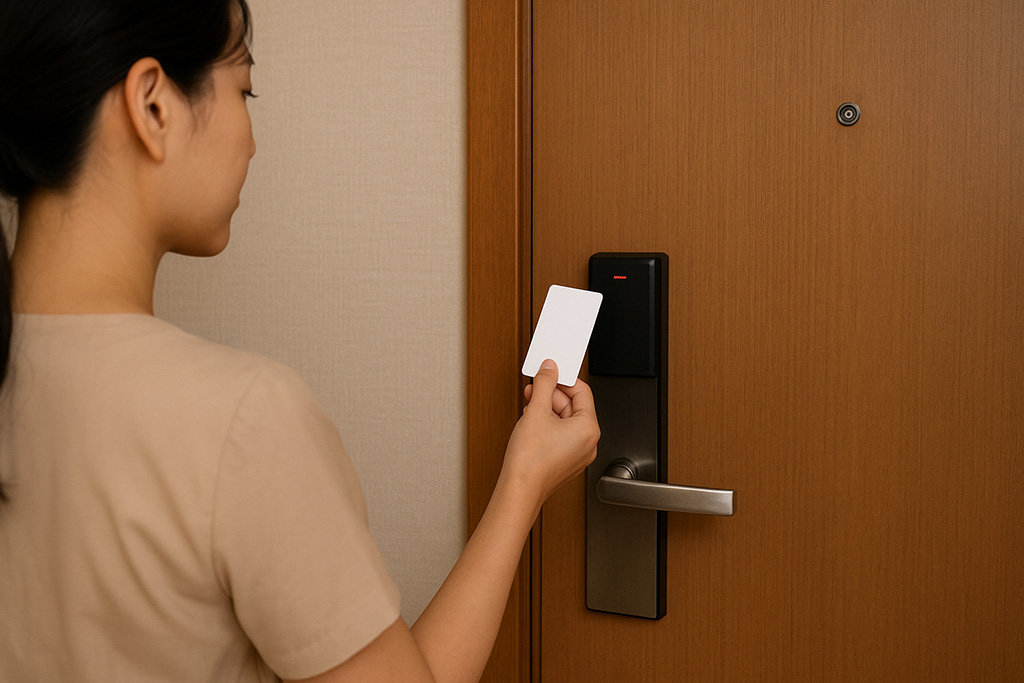
The most common application is, of course, guest room Access. With RFID, hotels can program Cards instantly, restrict Access after checkout, and integrate the card with lighting and air-conditioning systems to save energy.
RFID plays a significant role in hotel gym management. Instead of giving out separate gym passes, hotels can program RFID Cards to grant gym Access only to eligible guests. This system:
Reduces unauthorized entry.
Tracks gym usage patterns.
Enhances security by ensuring only current guests use the facility.
RFID Cards also control employee Access to storage rooms, kitchens, and administrative offices. This minimizes theft, ensures only authorized staff enter sensitive areas, and provides accountability through Access logs.
Guests appreciate the simplicity of tapping their card instead of fumbling with Keys. RFID Cards can also be linked to cashless payments, allowing guests to charge spa treatments, meals, or gym sessions directly to their room.
RFID encryption reduces the chance of counterfeit Keys. If a card is lost, it can be immediately deactivated, preventing unauthorized entry.
RFID systems generate Access logs that show when rooms, gyms, or facilities were used. This data helps hotels improve service planning, identify peak hours, and tailor marketing strategies.
While the initial investment is higher, RFID reduces long-term expenses by:
Lowering lock replacement costs.
Reducing staff time needed for reprogramming Keys.
Extending card life compared to magnetic stripes.
Even though RFID Cards are secure, lost Cards remain a practical issue. Hotels must balance convenience with guest education about promptly reporting lost Cards.
Hotels with older systems face significant costs when upgrading to RFID infrastructure. The transition requires not just new Cards but also door lock replacements, software upgrades, and staff training.
A growing trend is replacing physical Cards with mobile Keys. Guests can use their Smartphones with NFC or Bluetooth technology to unlock doors, eliminating the need for plastic Cards entirely.
Future systems may integrate biometric authentication—such as fingerprints or facial recognition—with RFID, adding another layer of security and personalization. This hybrid approach could further enhance convenience and reduce fraud.