Welcome To HuiXin IIOT : Pioneering RFID Solutions for a Connected World!

Barcode is a graphical representation method of information, which can be made into a barcode and then input into a computer using corresponding scanning devices. The currently common ones are one-dimensional barcodes and two-dimensional barcodes.
A one-dimensional barcode only expresses relevant information in one direction (usually horizontal) and does not express any information in the vertical direction. It usually has a certain height for the convenience of reader alignment. Its characteristics are fast information input, low error rate, but small data capacity, and barcode cannot be read after being damaged.
A two-dimensional barcode is a barcode that stores information in a two-dimensional space in both horizontal and vertical directions. It is an application technology that uses a specific geometric shape to distribute (black and white alternating) graphics on a plane to record information. It can be divided into stacked/row type two-dimensional codes and matrix type two-dimensional codes. Among them, the stacked/row arranged QR code is formed by stacking multiple short one-dimensional codes; Matrix QR codes are composed in the form of matrices, with "dots" representing binary "1" and "spaces" representing binary "0" at the corresponding element positions of the matrix. The code is composed of the arrangement of "dots" and "spaces".
Two dimensional barcodes make up for the shortcomings of one-dimensional barcodes, characterized by high information density and large capacity. They can not only prevent errors but also correct them. Even if the barcode is partially damaged, they can restore the correct information and are suitable for reading on various reading devices.
Radio Frequency Identification (RFID) technology, commonly known as electronic tags. RFID is a non-contact automatic identification technology mainly used to establish unique identity identifiers for various items, and is an important supporting technology for the Internet of Things.
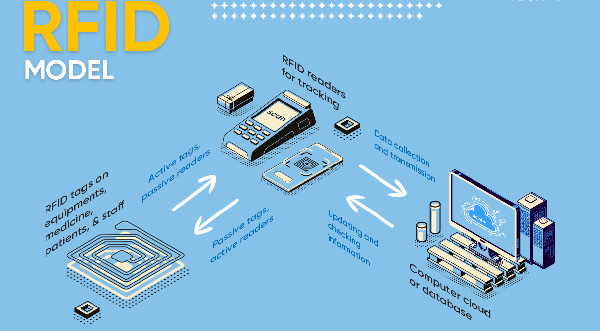
Radio Frequency Identification (RFID) technology
The RFID system consists of electronic tags, readers, and computers serving as servers. Among them, electronic tags contain RFID chips and antennas. Its working principle is that when the user uses the reader to operate the electronic tag on the item, the reader antenna sends electromagnetic signals to the tag, communicates with the tag, and the RFID code in the tag is transmitted back to the reader. The reader then communicates with the system server to query the description information of the item based on the code.
Working principle of RFID system
RFID tags are divided into active and passive tags. Active tags are powered by batteries and can work at a distance of more than 10 meters from the reader, but they are more expensive and have fewer applications; Currently, passive tags are commonly used in practical applications, mainly powered by extracting energy from the electromagnetic field emitted by the reader. The distance between the tag and the reader during operation is about 1 meter.
Barcode technology vs. RFID
Barcode technology and RFID technology are known as the item identity cards of the Internet of Things era because they can both be used to store information about items and represent their identity to some extent. However, RFID stores more information and can serve as a unique identification for items. In addition, there are many differences between the two:
(1) Barcodes do not have read-write functions, and information cannot be added to already printed barcodes; RFID tags can be read and written, and RFID readers can communicate information with tags and modify stored information within the allowable range of tag design.
(2) Barcode readers need to align and read printed barcodes at close range, and barcodes only support close range reading; RFID tags support longer reading distances, and RFID readers do not need to align active or passive RFID tags for close range reading.
RFID tags are usually more durable and sturdy than barcodes; But RFID tags are also much more expensive than barcodes.

Plus regular updates, exclusive discounts and the latest product news!