Welcome To HuiXin IOT : Pioneering RFID Solutions for a Connected World!
With the continuous development of science and technology, especially in the field of security management and information technology, RFID (Radio Frequency Identification) technology is gradually being widely used in identity authentication and access control systems. RFID card, as a carrier of this technology, provides a fast, accurate, and secure way to authenticate and authorize an individual's access to a specific area. In this article, we will discuss in detail the basic concepts of RFID Cards, the uniqueness of RFID technology in the industry, as well as the advantages and disadvantages of using RFID Cards for access control and identification, and finally summarize the scenarios where they are applicable and the direction of future development.
What is RFID card?
RFID card is a card that transmits information through radio frequency signals, usually consisting of a chip and an antenna. Through RFID technology, RFID Cards are able to exchange information with RFID readers without the need for direct contact or visual alignment. RFID Cards are widely used in various types of identity authentication, access control systems, asset management and other fields.
We offer many types of RFID Cards, including:
RFID Hotel Card
Mainly used in hotel room door locking system, using RFID technology, so that residents can easily swipe the card to open the door without the need for traditional keys, but also can be used for the elevator, gym, restaurant, and other internal hotel consumption and rights management.
info-1-1
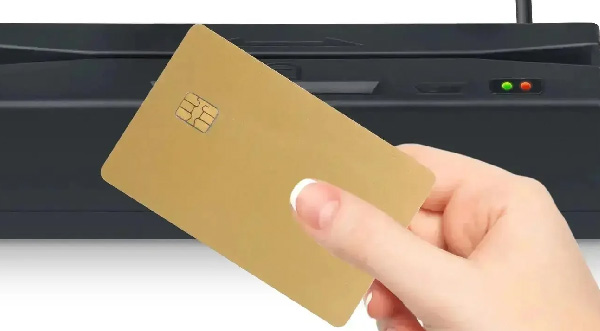
RFID Contact Card
A smart card that requires physical contact with a card reader for data exchange, with a built-in chip, usually used in application scenarios with high security requirements such as bank payment Cards, ID Cards, etc., and needs to be inserted into or close to a specific terminal device when reading the card.
info-1-1
RFID Blank Card
RFID Cards without any printed information on the surface, suitable for personalization, such as printing LOGO, number or user information, can be used for access control, time and attendance, membership management and other purposes.
info-1-1
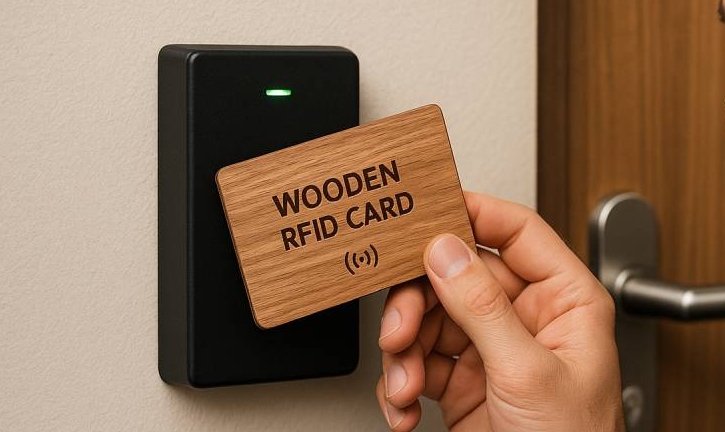
RFID Wooden Card
Wooden Cards are eco-friendly RFID Cards made from wood, suitable for environmentally friendly hotels, membership Cards, and gift Cards. They incorporate RFID functionality and support custom engraving or printing.
info-1-1
RFID Clamshell Card
Thicker than normal RFID Cards, may contain an antenna or chip layer inside, suitable for long-term use, such as access control, parking lot access control, etc. Due to the increased thickness, they are usually more durable than standard PVC Cards.
info-1-1
RFID Contactless Card
Communicate with the reader through radio waves without physical contact, mainly used for public transportation Cards, access control Cards, bank Cards and other applications, providing faster reading speed and better durability, widely used in various industries.
info-1-1
RFID Magnetic Stripe Card
Traditional card type with a black or brown magnetic stripe on the back, storing user information through the magnetic stripe, which needs to be read by swiping the card, commonly used in credit Cards, membership Cards, access Cards, etc., but the security is relatively low.
info-1-1
RFID Composite Card
Combining multiple technologies (e.g. RFID + magnetic stripe + IC chip) smart card, suitable for applications requiring multiple authentication methods, such as enterprise access control, payment, identification, etc., with a higher degree of compatibility and security, and can simultaneously support different types of card-reading devices.
Different types of RFID Cards are suitable for different application scenarios, and you can choose the right type of card according to your needs.
What is unique about RFID technology Cards in the technical card industry?
The application of RFID technology in identity verification and item tracking has unparalleled advantages over traditional magnetic stripe and barcode Cards. First of all, RFID Cards are capable of non-contact identification. Users do not need to insert the card into the device, but simply bring it close to the reader to complete the information transfer. In addition, RFID card reading speed is faster, can be completed within a few seconds of identity authentication, greatly enhancing the efficiency.
Secondly, RFID technology has a large data storage capacity, which can store more information, such as identity information, account balance, access rights, etc., and this information can be easily updated at a later stage. In addition, RFID Cards are highly resistant to interference, can work reliably in complex environments, and support multiple Cards to be read simultaneously.
Most importantly, RFID technology provides a higher level of security. Through encrypted transmission and dynamic authentication, RFID Cards can effectively prevent information from being stolen or forged, and are therefore widely used in payment, authentication and other fields.